April 22, 2026

Press Releases

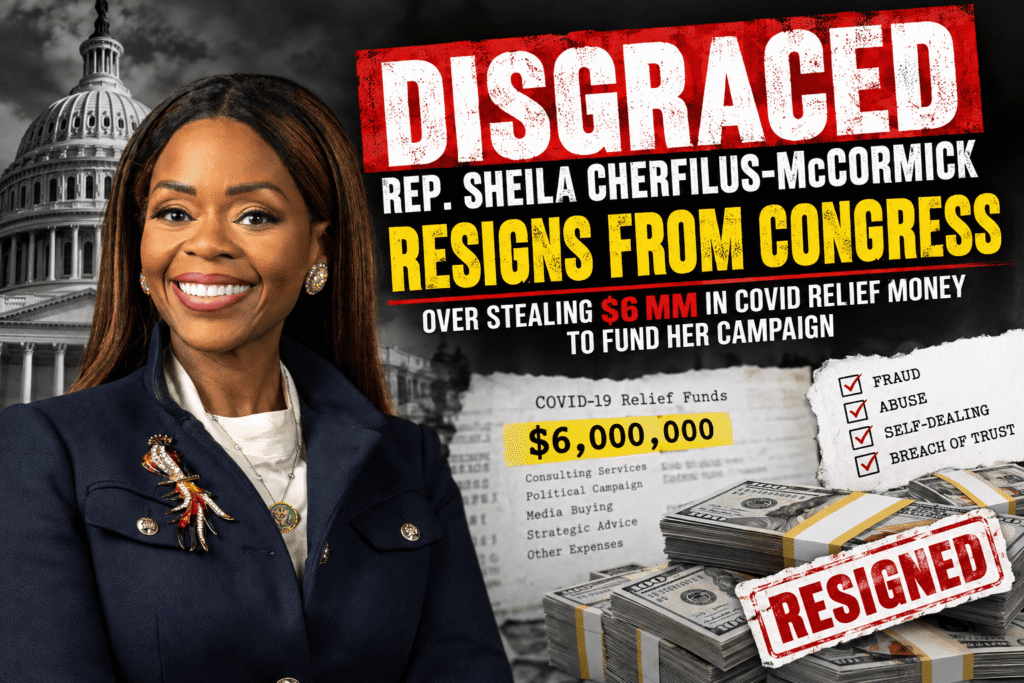
Disgraced Rep. Sheila Cherfilus-McCormick resigns from Congress over stealing $6 MM in COVID relief money to fund her campaign

Washington, D.C. — Rep. Sheila Cherfilus-McCormick resigned from Congress this week as she faces a 15-count federal criminal indictment carrying a maximum sentence of 53 years in prison. “We are pleased to see that justice will be served in this situation,” said Dan Backer, president of the Coolidge Reagan Foundation. “The scope of this scheme is unprecedented, and American taxpayers should be horrified that this two-bit crook was ever allowed to serve in our nation’s capital.” Last year, the Coolidge Reagan Foundation filed both an FEC complaint and a criminal referral to the Florida Attorney General against Cherfilus-McCormick for alleged fraud, embezzlement, and campaign finance violations. The FEC complaint detailed how Cherfilus-McCormick’s campaign accepted more than $150,000 in illegal, unreported in-kind contributions from the nonprofit Truth & Justice, Inc. as part of her overall $6 Million multi-entity embezzlement of covid relief funds she stole and loaned to her campaign. The “Truth & Justice” funds were used to cover printing and mailing costs her campaign could not afford, which is prohibited under federal law. The criminal referral outlined how Cherfilus-McCormick, as CEO of Trinity Healthcare Services, exploited a state payment error to divert nearly $5 million in taxpayer funds for personal use, funneling much of it into her campaign through entities she controlled. “These findings exposed a pattern of corruption, and now, she’ll be held accountable for defrauding taxpayers and breaking federal law,” Backer said. “Her resignation is proof that even she knows her conduct is indefensible – politically and legally.” For months, the political establishment tried to look the other way, but not the team at the Coolidge Reagan Foundation. We followed the money, filed complaints, and did everything we could to ensure the media knew the truth about Cherfilus-McCormick. This shameful situation underscores the need for stronger enforcement of campaign finance laws and greater accountability for elected officials who attempt to use public office as a personal ATM. ### For Interview or Inquiry: Media Contact: Ashley Losoya ashley@prosepolitical.com About The Coolidge Reagan Foundation For more than a decade, the Coolidge Reagan Foundation has defended free speech, exposed corrupt politicians, and protected election integrity, ensuring America’s founding principles endure. Its 2018 complaint against Hillary Clinton and the Democratic National Committee over the unlawful funding of the Steele Dossier led to a six-figure fine—the only fine ever levied against her. The foundation’s 2019 complaint against Bernie Sanders for hiring illegal aliens led to a five-figure penalty, and it has fearlessly taken on the political corruption of Reps. Alexandria Ocasio-Cortez, Cori Bush, Jasmine Crockett, and Rashida Tlaib, among others. For more information, visit: www.coolidgereagan.org.
Blog

INDICTED: A Reckoning Begins for the Southern Poverty Law Center

For years, the Southern Poverty Law Center (SPLC) positioned itself as one of the most powerful arbiters of extremism in American life. Through its “Hate Map” and influence over corporations, financial institutions, and tech platforms, it shaped reputations and restricted access to services for countless individuals and organizations. Now, that same institution is facing serious federal charges. The U.S. Department of Justice has just announced an eleven-count indictment against the SPLC, alleging wire fraud, false statements to a bank, and conspiracy to commit money laundering. According to prosecutors, the alleged scheme spans nearly a decade, from 2014 through 2023, and remains part of an ongoing federal investigation. At the heart of the indictment are deeply troubling allegations about how donor funds were used. Federal prosecutors allege that the SPLC directed more than $3 million in funds to individuals connected to violent extremist organizations. These groups reportedly included factions associated with the Ku Klux Klan, Aryan Nation, National Alliance, and others widely recognized for racist and extremist activity. The indictment further alleges that financial structures, including accounts opened under fictitious entities, were used to obscure the source and control of those funds. Even beyond questions of legality, the underlying conduct described in the indictment raises serious ethical concerns. An organization that built its reputation on “exposing hate” is now accused of financially engaging with individuals tied to the very movements it claimed to oppose. Whether ultimately proven in court or not, that contradiction alone demands public scrutiny. According to the indictment, one alleged source connected to the SPLC participated in online leadership discussions tied to the planning of the violent 2017 “Unite the Right” rally in Charlottesville, Virginia. That individual allegedly engaged in racist communications and helped coordinate logistics related to the event. These claims, if substantiated, would represent a stunning departure from the organization’s stated mission. Federal officials have underscored the seriousness of the case. Law enforcement leadership has pointed to alleged misrepresentations made to donors and the potential misuse of funds that were given under the premise of ‘combating extremism.’ The core allegation is not just financial misconduct, but a breakdown in trust between the organization and those who financially supported it. That trust matters. For decades, big corporations, major foundations, and everyday Americans contributed to the SPLC believing they were supporting legitimate civil rights efforts. Those same donors now face serious questions about how their contributions may have been used. If the allegations are proven in court, it would represent not just legal wrongdoing, but a fundamental breach of the expectations that sustain the nonprofit sector. This moment also raises broader questions about influence. The SPLC has played a central role in shaping how extremism is defined and enforced across American institutions. Financial companies such as PayPal (exposed by SPLC, partnered with ADL), Apple Pay (opened iTunes donations for the SPLC), Mastercard and VISA (cut off David Horowitz), have relied on SPLC data in efforts to restrict services or broaden support for the SPLC. Technology and other various platforms including Cloudflare (following the “Unite the Right” rally), Airbnb (following January 6), Discord, SquareSpace, GoFundMe, GoDaddy, Spotify (and many others) have used similar frameworks to determine access and remove users or content. Eventbrite has even cited SPLC designations as part of its enforcement policies against organizers it deems to be promoting hate or discrimination. In effect, one nonprofit organization helped inform decisions that impacted speech, commerce, travel, and participation in the digital public square. That reality makes the current allegations even more significant. If an institution with that level of influence is found to have operated with internal contradictions or misrepresented its activities, the implications extend far beyond a single case. It calls into question the broader ecosystem that relied on its judgments and classifications. It also reinforces a deeper concern that has been raised for years: When organizations derive influence from identifying threats, there is always the risk that the incentive to sustain relevance begins to shape behavior. This specific indictment brings that concern into sharp focus. None of this replaces the need for due process. An indictment is not a conviction, and the judicial system exists to evaluate evidence, determine facts, and deliver a fair outcome. That process should play out fully and without interference. However, accountability does not begin at conviction. It begins with scrutiny, transparency, and a willingness to confront difficult questions. This moment represents exactly that. For those who have long questioned whether certain institutions operate under a different set of rules, the indictment signals a shift. It suggests that accountability, even for the most influential organizations, is not out of reach. And it underscores a simple principle that should apply universally: No organization is above the standards it imposes on others. As this case unfolds, the facts will become clearer and the legal process will determine the appropriate outcome, however, the broader conversation about trust, influence, and accountability in American institutions is already underway. That conversation has been long overdue.

Scroll to Top